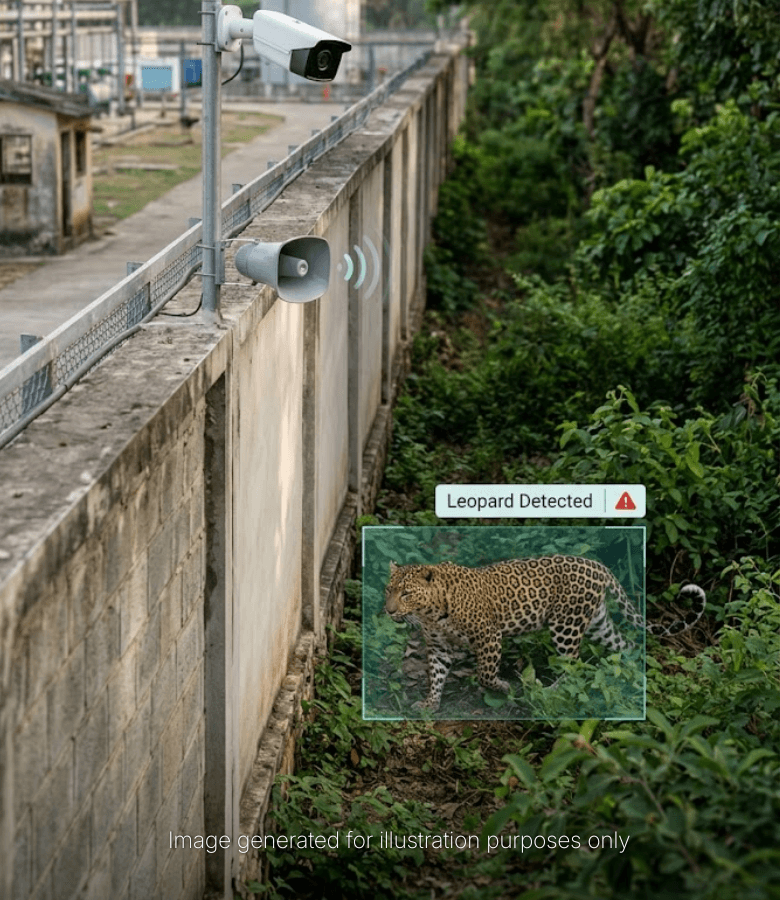
The chemical plant is located near a forested area where leopards are known to frequent the facility boundary. Workers moving between buildings, operating near boundary walls, or working late shifts were at genuine risk of encountering a leopard without any prior warning. The existing CCTV infrastructure recorded footage but had no intelligence layer - leopard sightings were only discovered after reviewing recordings, by which time any encounter had already occurred.
With no automated detection or deterrent in place, the facility had no way to warn workers or discourage the animal before it moved further into the premises. A single undetected leopard near an active work area represented a direct life-safety risk with no response mechanism.
Problem Statement
THE CHALLENGE
Challenges
-
Basic CCTV with no detection capability
Existing cameras recorded but could not identify or flag leopard presence in real time.
-
No automated deterrent
No mechanism existed to discourage the leopard from approaching further once spotted near the boundary.
-
Worker safety at risk near boundary zones
Staff working near boundary walls or moving between buildings had no warning system for wildlife presence.
-
Night detection complexity
Low light conditions near boundary walls made reliable detection challenging - with reduced visibility causing detection delays during night hours.
-
Visual similarity to background
Leopard coat pattern and shading closely matches natural backgrounds and boundary wall textures - leading to occasional false positives in detection.
Solution
THE SOLUTION
We deployed a computer vision system on the existing boundary wall camera infrastructure trained specifically to detect leopards across day and night conditions - with the model accounting for low light delays and false positive reduction from background similarity. The moment a leopard is identified near the boundary, an instant alert is sent to the security team and an IP speaker is automatically activated - playing a deterrent sound to encourage the leopard to move away before it comes closer.
Flow: Live boundary camera feed -> Leopard detected -> Security team alerted -> IP speaker activated automatically -> Leopard deterred -> Incident logged with image and timestamp
-
Existing boundary wall cameras integrated with AI detection layer - no new hardware required.
-
Model trained to identify leopards across day and night conditions - night detection operates with slight delay due to reduced visibility but remains reliable for early warning.
-
False positive reduction built into model training - leopard coat pattern differentiated from similar background textures and shading.
-
Instant alert sent to the security team with location, camera ID, and image on every detection.
-
IP speaker activated automatically on detection - deterrent sound played to discourage leopard from approaching further.