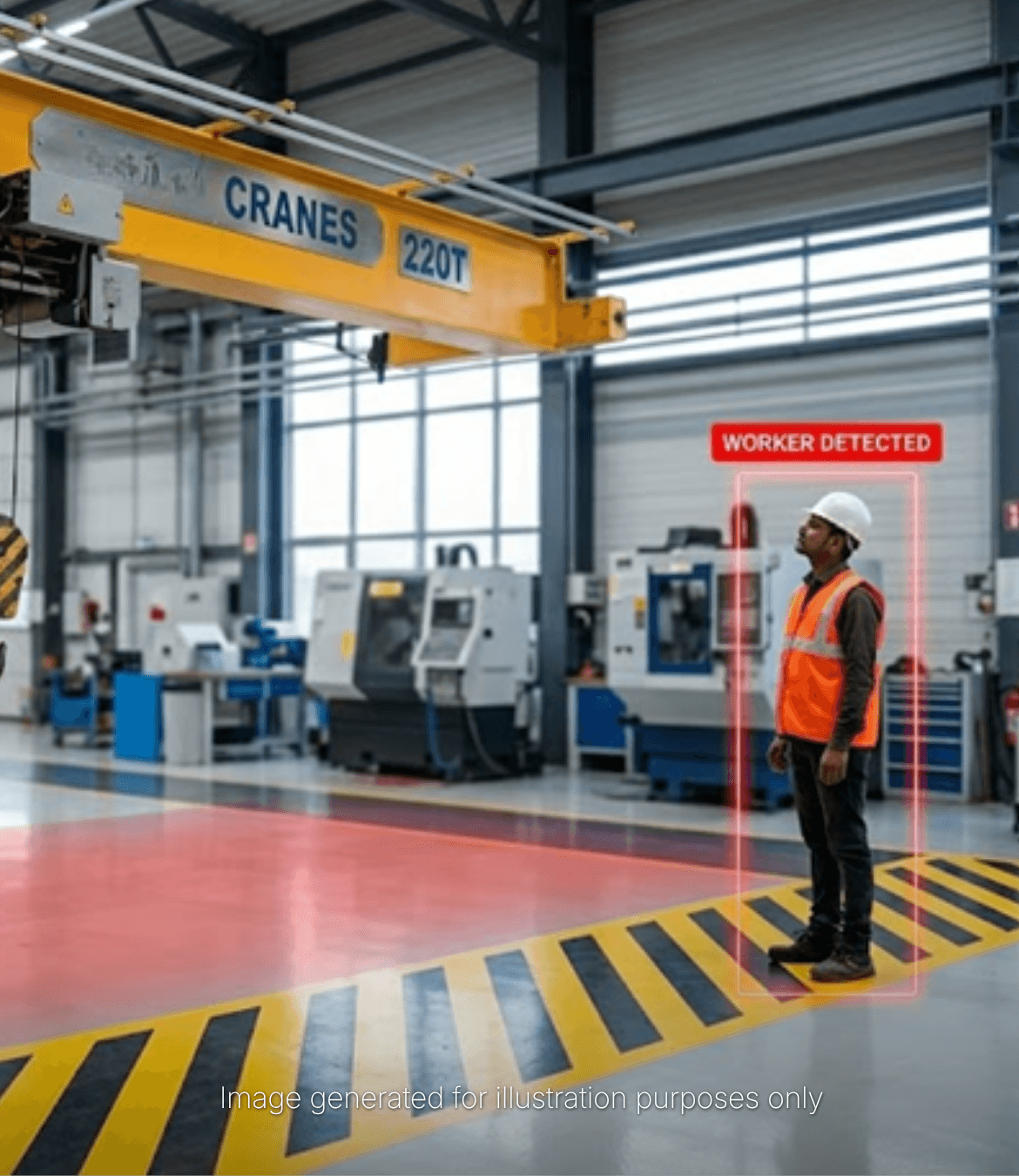
A safety audit at the automobile manufacturing facility flagged a critical risk - no continuous monitoring existed for personnel working beneath or near suspended loads. Cranes and lifting machinery operated across the assembly floor throughout the day, and the only oversight in place was periodic supervisor checks. Between checks, workers were routinely in proximity to active crane operations with no automated safety layer in place.
The assembly process added further complexity. During engine assembly, workers needed to work in very close proximity to the suspended load for a defined duration - a necessary operational step that could not simply be stopped. Any safety system needed to distinguish between a genuine violation and an approved assembly window, without interrupting production unnecessarily.
Problem Statement
THE CHALLENGE
Challenges
-
No dedicated monitoring system
No automated detection existed. Supervisor periodic checks were the only oversight, leaving significant unmonitored windows.
-
Safety audit flagged critical compliance gap
Existing processes did not meet safety standards for suspended load zones - exposing the facility to regulatory risk and potential liability.
-
Assembly proximity created false positive risk
Workers legitimately needed to be close to suspended loads during engine assembly - a blanket stop trigger would have disrupted production continuously.
-
No automated crane stop mechanism
Even when a supervisor spotted a violation, stopping the crane required manual intervention - adding critical seconds to response time.
Solution
THE SOLUTION
We deployed a computer vision system that continuously monitors all suspended load zones across the facility. For the first time, the facility had a dedicated automated system to detect personnel in suspended load zones - triggering an immediate crane stop the moment a person is detected. For approved assembly operations where close proximity is necessary, an override logic was built in to allow the assembly window to complete smoothly without triggering a stop.
Flow: Live camera feed -> Person detected in suspended load zone -> Assembly override check -> If not in override window - relay triggered - crane stops immediately -> Alert sent to supervisor -> Incident logged on dashboard.
-
Continuous zone monitoring across all crane and lifting machinery areas via existing camera infrastructure.
-
Immediate crane stop triggered via relay integration the moment an unauthorised person is detected beneath a suspended load - response in seconds.
-
Assembly override logic built in - when engine assembly requires close proximity, the system recognises the approved window and allows the operation to complete without triggering a stop.
-
Real-time supervisor alert sent on every detection event with zone, timestamp, and image.
-
Full incident log maintained on dashboard for every detection, override, and crane stop event.