Paper mills are among the highest fire-risk environments in manufacturing. Raw material stockpiles - pulp, paper rolls, dry fibre - are highly combustible, and heat is generated continuously across production. A fire undetected for even two minutes can spread across an entire bay before response arrives.
The facility relied on manual fire watch patrols and conventional point-type heat sensors spaced at fixed intervals. Sensors were blind to ground-level ignitions and localised hotspots between coverage zones. Manual patrols couldn't cover every critical area simultaneously - especially during night shifts.
Problem Statement
THE CHALLENGE
Challenges
-
Sensor gaps left zones unmonitored
Ceiling-mounted sensors missed ground-level ignitions and fires starting between coverage intervals.
-
Manual patrol had critical blind spots
No single guard could cover storage bays, conveyor runs, and production floors simultaneously.
-
Small fires escalated before detection
In paper dust and dry pulp environments, a small ignition becomes a facility-threatening fire in under four minutes.
Solution
THE SOLUTION
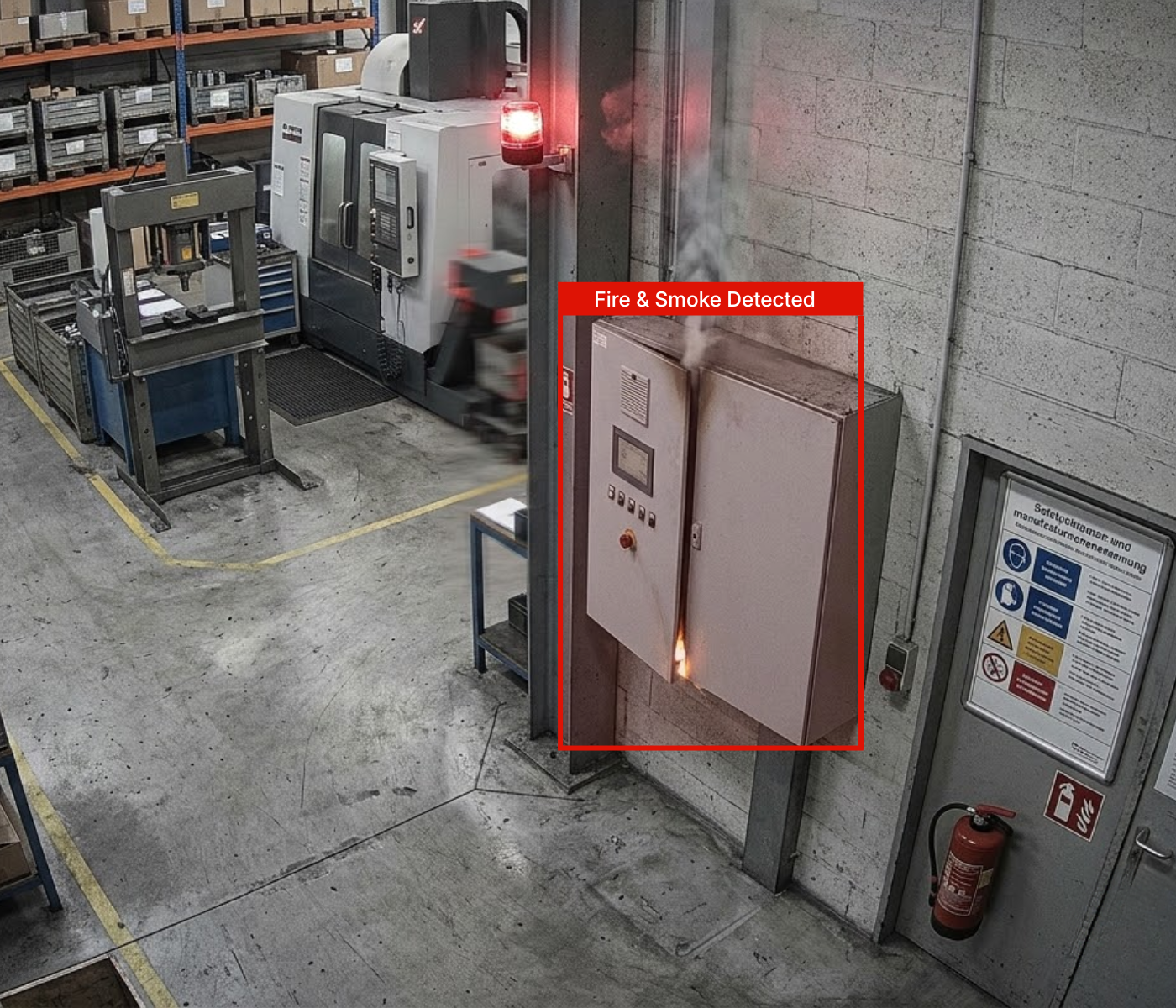
We deployed an AI fire detection system that connects to the facility's existing CCTV infrastructure across raw material storage, processing areas, finished goods warehousing, and other areas. The system processes live video continuously, identifies flame signatures in real time, and triggers automated alerts before fire has time to spread.
Flow: Live camera feed → AI detects flame signature → Alert sent to control room → Zone and camera location flagged on dashboard → Incident recorded with timestamp
-
Flame detection via existing CCTV - AI processes live feeds to identify early-stage flame, covering blind spots conventional sensors miss.
-
Alert in under 15 seconds - From flame appearance to control room notification, before it has time to spread.
-
Exact zone and location flagged - Response teams know precisely where to go the moment the alert fires.
-
Connects to existing alarm panel - Automated suppression activation with no manual confirmation required.
-
24/7 coverage with no blind shifts - No breaks, no fatigue, no patrol gaps. Every zone is monitored continuously.